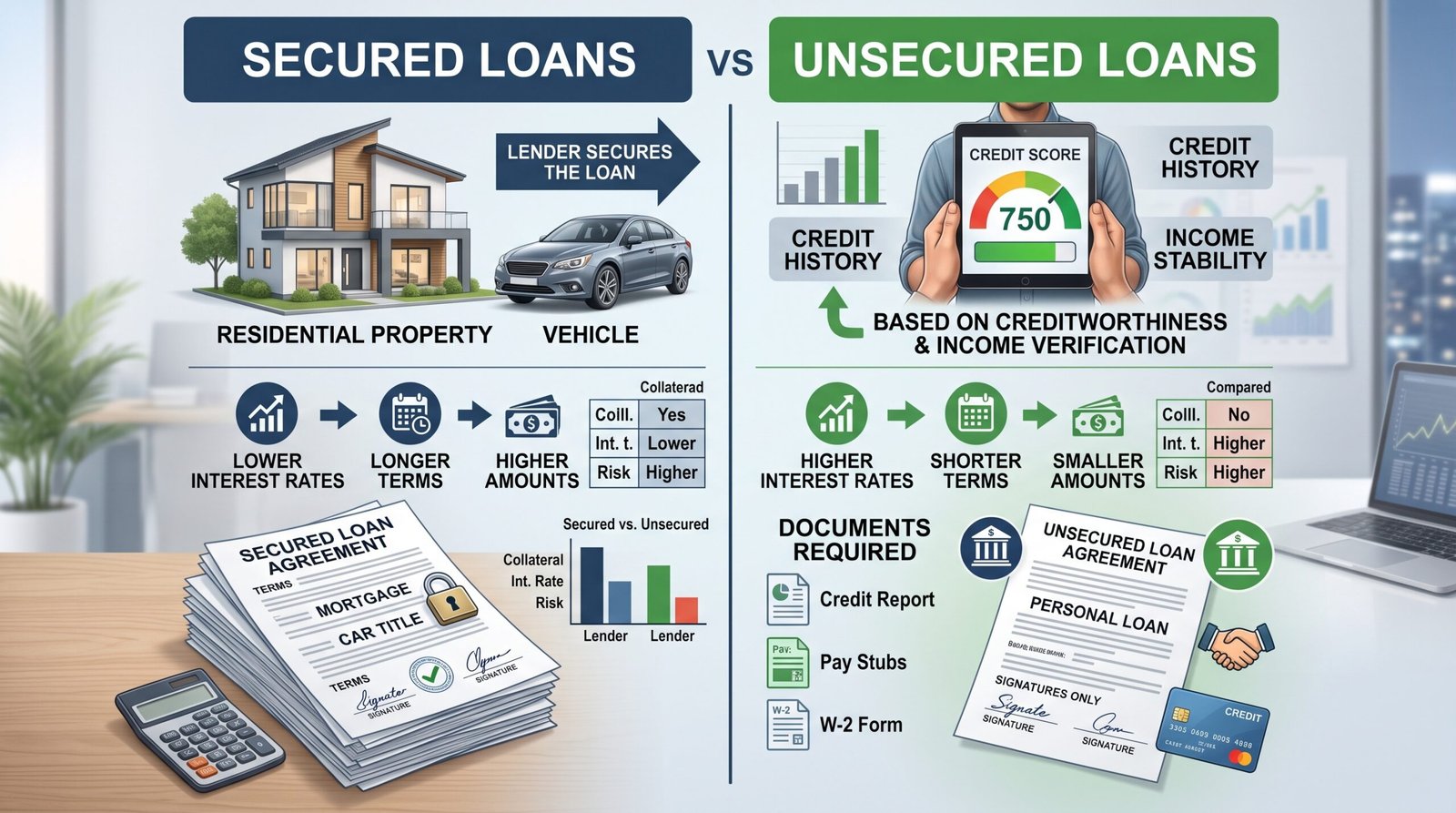
Secured Vs Unsecured Loans Explained
Introduction
Loans play a major role in personal and business finance by providing access to funds for various purposes. Whether an individual wants to purchase a home, finance education, cover medical expenses, or expand a business, loans can provide the necessary financial support. However, not all loans operate in the same way.
One of the most important distinctions in lending is the difference between secured loans and unsecured loans. These two categories differ in terms of collateral requirements, approval processes, interest rates, risk levels, and repayment conditions.
Understanding the differences between secured and unsecured loans helps borrowers make informed financial decisions and select loan products that align with their financial needs and repayment capabilities.
This guide explains secured and unsecured loans, their features, advantages, disadvantages, and the key factors borrowers should consider before applying.
What Is a Loan?
A loan is a financial agreement in which a lender provides money to a borrower with the expectation that the borrower will repay the amount over a specified period, usually with interest.
Loan agreements typically include:
- Loan amount
- Interest rate
- Repayment period
- Monthly payment amount
- Fees and charges
- Terms and conditions
Loans generally fall into two main categories:
- Secured loans
- Unsecured loans
What Is a Secured Loan?
A secured loan is a type of borrowing that requires the borrower to provide collateral.
Collateral is an asset that the lender can claim if the borrower fails to repay the loan.
Common forms of collateral include:
- Real estate
- Vehicles
- Savings accounts
- Investments
- Business assets
- Equipment
Collateral reduces the lender’s financial risk.
Examples of Secured Loans
Several common financial products are secured loans.
Examples include:
Mortgage Loans
Collateral:
- Residential property
- Commercial property
Auto Loans
Collateral:
- Purchased vehicle
Home Equity Loans
Collateral:
- Home equity
Secured Personal Loans
Collateral:
- Savings accounts
- Certificates of deposit
- Other financial assets
Business Loans
Collateral:
- Equipment
- Inventory
- Property
Secured loans are widely used because they reduce lender risk.
How Secured Loans Work
The secured loan process generally follows these steps:
Step 1: Application
The borrower submits:
- Personal information
- Financial information
- Collateral details
Step 2: Collateral Evaluation
The lender evaluates:
- Asset value
- Ownership status
- Market conditions
Step 3: Credit Assessment
The lender reviews:
- Credit history
- Income
- Debt obligations
Step 4: Loan Approval
If approved, the lender issues the loan.
Step 5: Repayment
The borrower repays according to the loan agreement.
If repayment fails, the lender may seize the collateral.
Advantages of Secured Loans
Secured loans provide several benefits.
Lower Interest Rates
Because collateral reduces lender risk, secured loans often have lower interest rates.
Higher Borrowing Limits
Borrowers may qualify for larger loan amounts.
Longer Repayment Terms
Repayment periods may extend over many years.
Easier Approval
Collateral can improve approval chances, especially for borrowers with limited credit history.
Improved Loan Flexibility
Lenders may offer more favorable conditions.
These advantages make secured loans attractive for major financial needs.
Disadvantages of Secured Loans
Secured loans also involve risks.
Risk of Asset Loss
Failure to repay may result in:
- Foreclosure
- Repossession
- Asset seizure
Longer Approval Process
Collateral verification can increase processing time.
Additional Documentation
Borrowers often provide:
- Ownership documents
- Appraisals
- Insurance records
Reduced Financial Flexibility
Collateral remains tied to the loan until repayment is complete.
Borrowers should carefully evaluate these risks.
What Is an Unsecured Loan?
An unsecured loan does not require collateral.
Approval decisions are based primarily on:
- Credit history
- Income
- Employment
- Financial stability
- Debt obligations
Because no collateral exists, lenders assume greater financial risk.
Examples of Unsecured Loans
Common unsecured loan products include:
Personal Loans
Used for:
- Medical expenses
- Travel
- Home improvements
- Debt consolidation
Credit Cards
Allow revolving borrowing without collateral.
Student Loans
Many educational loans do not require collateral.
Medical Loans
Some healthcare financing options are unsecured.
Signature Loans
Approval depends primarily on borrower creditworthiness.
These loans provide flexibility without requiring assets.
How Unsecured Loans Work
The unsecured loan process generally includes:
Step 1: Application Submission
Applicants provide:
- Personal information
- Employment information
- Financial records
Step 2: Credit Evaluation
Lenders review:
- Credit scores
- Payment history
- Existing debt
Step 3: Income Verification
Income and employment are verified.
Step 4: Risk Assessment
Lenders estimate repayment risk.
Step 5: Loan Approval
Approved applicants receive funds without providing collateral.
Advantages of Unsecured Loans
Unsecured loans offer several benefits.
No Collateral Requirement
Borrowers do not risk losing personal assets.
Faster Approval Process
Applications often require less documentation.
Simpler Application Procedures
Fewer asset evaluations are required.
Greater Asset Protection
Personal property remains unaffected by the loan agreement.
Financial Flexibility
Borrowers can access funds without pledging property.
These features make unsecured loans attractive for many consumers.
Disadvantages of Unsecured Loans
Unsecured loans also have limitations.
Higher Interest Rates
Because lenders assume greater risk, interest rates are often higher.
Lower Borrowing Limits
Loan amounts may be restricted.
Stricter Approval Requirements
Lenders may require:
- Higher credit scores
- Stable employment
- Strong income history
Shorter Repayment Periods
Repayment schedules may be shorter.
Borrowers should consider these factors carefully.
Major Differences Between Secured and Unsecured Loans
Several key differences distinguish these loan types.
| Feature | Secured Loans | Unsecured Loans |
|---|---|---|
| Collateral | Required | Not Required |
| Interest Rates | Usually Lower | Usually Higher |
| Approval Difficulty | Easier | More Difficult |
| Loan Amount | Higher | Lower |
| Repayment Terms | Longer | Shorter |
| Risk to Borrower | Asset Loss | Credit Damage |
| Processing Time | Longer | Faster |
Understanding these differences helps borrowers choose appropriately.
Interest Rate Comparison
Interest rates vary significantly between loan types.
Secured Loan Rates
Interest rates may be lower because lenders have collateral protection.
Examples:
- Mortgages
- Auto loans
- Secured personal loans
Unsecured Loan Rates
Interest rates may be higher because lenders accept more risk.
Examples:
- Credit cards
- Personal loans
- Signature loans
Credit scores also influence final interest rates.
Which Loan Is Easier to Obtain?
Approval difficulty depends on several factors.
Secured Loans
Borrowers may qualify more easily because collateral reduces lender risk.
Unsecured Loans
Lenders rely heavily on:
- Credit scores
- Income
- Employment stability
Applicants with strong financial histories often qualify more easily.
Which Loan Is Safer?
The answer depends on perspective.
Borrower Perspective
Unsecured loans protect personal assets.
Lender Perspective
Secured loans reduce financial losses.
Both loan types involve different risks and benefits.
When Should You Choose a Secured Loan?
Secured loans may be suitable when:
- Large amounts are required
- Lower interest rates are desired
- Long repayment periods are needed
- Valuable collateral is available
Examples include:
- Home purchases
- Vehicle financing
- Business investments
When Should You Choose an Unsecured Loan?
Unsecured loans may be appropriate when:
- Immediate funds are required
- No collateral is available
- Smaller loan amounts are needed
- Asset protection is important
Examples include:
- Medical expenses
- Debt consolidation
- Emergency expenses
Factors to Consider Before Choosing a Loan
Before borrowing, evaluate:
Financial Goals
Determine the purpose of the loan.
Repayment Ability
Calculate monthly repayment capacity.
Interest Costs
Compare borrowing costs.
Risk Tolerance
Assess willingness to provide collateral.
Loan Terms
Review:
- Interest rates
- Fees
- Repayment schedules
- Penalties
Careful evaluation reduces financial risk.
Common Borrower Mistakes
Common mistakes include:
- Borrowing more than necessary
- Ignoring interest costs
- Failing to compare lenders
- Overlooking repayment obligations
- Using collateral carelessly
- Missing payment deadlines
Avoiding these mistakes improves financial outcomes.
Example Comparison
Suppose two borrowers need $20,000.
| Feature | Secured Loan | Unsecured Loan |
|---|---|---|
| Loan Amount | $20,000 | $20,000 |
| Interest Rate | 7% | 13% |
| Repayment Period | 5 Years | 3 Years |
| Monthly Payment | Lower | Higher |
| Collateral | Required | Not Required |
This example illustrates the trade-offs between loan types.
Conclusion
Secured and unsecured loans each serve important financial purposes. Secured loans offer lower interest rates, larger borrowing amounts, and easier approval but require collateral. Unsecured loans provide greater flexibility and asset protection but often involve higher interest rates and stricter approval requirements.
Choosing between secured and unsecured loans depends on financial goals, risk tolerance, available assets, and repayment capacity. Understanding the differences between these loan types helps borrowers make informed financial decisions and manage debt responsibly.
Frequently Asked Questions (FAQ)
What is the main difference between secured and unsecured loans?
Secured loans require collateral, while unsecured loans do not.
Are secured loans easier to obtain?
In many cases, yes, because collateral reduces lender risk.
Do unsecured loans have higher interest rates?
Yes. Unsecured loans often carry higher interest rates due to increased lender risk.
Can I lose my property with a secured loan?
Yes. Failure to repay may result in the lender claiming the collateral.
Which loan type is safer for borrowers?
Unsecured loans generally provide greater asset protection.
Can I get an unsecured loan with poor credit?
Approval may be more difficult, but some lenders offer options for borrowers with lower credit scores.
Which loan type is better?
The best choice depends on individual financial circumstances, borrowing needs, and risk tolerance.

Related Posts

Tips For Paying Off Loans Faster

How Loan Interest Rates Are Calculated